From Wikipedia, the free encyclopedia

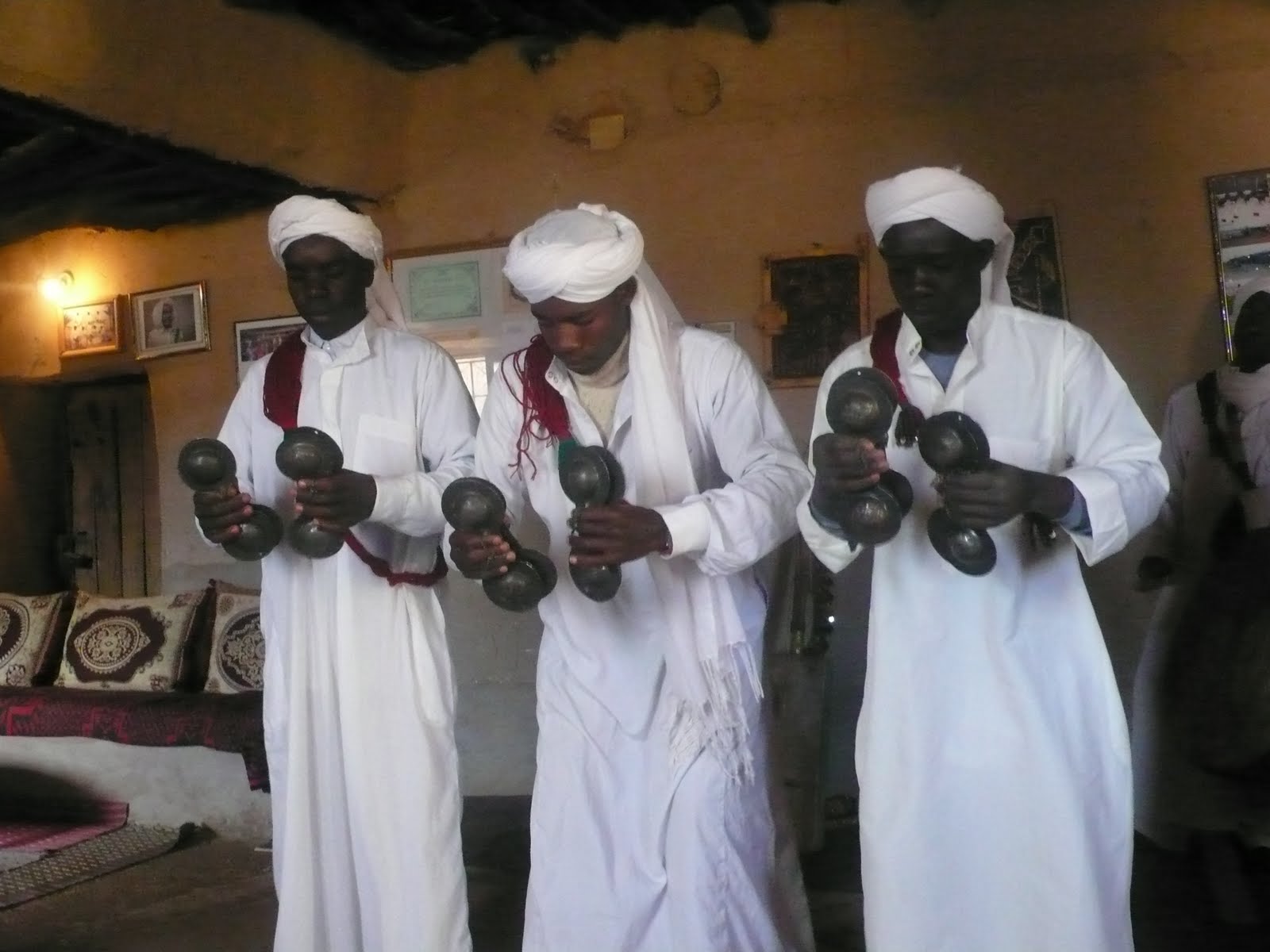
Gnawa musicians performing in a street in Morocco
Gnawa music is a mixture of sub-Saharan African, Berber, and Arabic religious songs and rhythms. It combines music and acrobatic dancing. The music is both a prayer and a celebration of life. Though many of the influences that formed this music can be traced to sub-Saharan Africa, and specifically, the Western Sahel, its practice is concentrated in north Africa, mainly Morocco. (See Gnawa for more details)
In a Gnawa song, one phrase or a few lines are repeated over and over throughout a particular song though the song may last a long time. In fact, a song may last several hours non-stop. The norm, though, is that what seems to the unintiniated to be one long song is actually a series of chants, which has to do with describing the various spirits (in Arabic mlouk (sing. melk)), so what seems to be a 20 minute piece may be a whole series of pieces, a suite for Sidi Moussa, Sidi Hamou, Sidi Mimoun or the others. But because they are suited for adepts in a state of trance, they go on and on, and have the effect, that they provoke trance from different angles.
The melodic language of the stringed instrument is closely related to their vocal music and to their speech patterns, as is the case in much African music. It is a language that emphasizes on the tonic and fifth, with quavering pitch-play, especially pitch-flattening, around the third, the fifth, and sometimes the seventh. This is the language of the blues.
Gnawa music is characterized by instrumentation. The large heavy iron castanets known as qraqab (or krakebs large iron castanets; Ar. قراقب) and a three -string lute known commonly as a hajhuj (or gimbri) are central to Gnawa music.(Schuyler, 2008) The rhythms of the Gnawa, like their instrumentations are distinctive. Particularly Gnawa is characterized by interplay between triple and duple meters. The “big bass drums” mentioned by Schuyler are not typically featured in a more traditional setting. (Schaefer, 2005)
Gnawa have venerable stringed-instrument traditions involving both bowed lutes like the gogo and plucked lutes like the gimbri (Ar. چنبري; also called hajhuj, Ar. هجهوج or "sentir" Ar. سنتير), a three-stringed bass instrument. The Gnawa also use large drums called tbel (Ar. طبل ) in their ritual music. The Gnawa hajhuj has strong historical and musical links to West African lutes like the Hausa halam, a direct ancestor of the banjo.
Gnawa hajhuj players use a technique which 19th century American minstrel banjo instruction manuals identify as "brushless drop-thumb frailing". The "brushless" part means the fingers do not brush several strings at once to make chords. Instead, the thumb drops repeatedly in a hypnotically rhythmic pattern against the freely-vibrating bass string producing a throbbing drone, while the first two or three fingers of the same (right) hand pick out, often percussive patterns in a drum-like, almost telegraphic manner.
[edit]Rituals
Gnawas perform a complex liturgy, called lila or derdeba. The ceremony recreates the first sacrifice and the genesis of the universe by the evocation of the seven main manifestations of the divine demiurgic activity. It calls the seven saints and supernatural entities (mluk, Arabic: ملوك) represented by seven colors, as a prismatic decomposition of the original light/energy. The derdeba is jointly animated by a maâlem (master musician) at the head of his troop and by moqadma or shuwafa(clairvoyante) who is in charge of the accessories and clothing necessary to the ritual.
During the ceremony, the clairvoyante determines the accessories and clothing as it becomes ritually necessary. Meanwhile, the maâlem, using the guembri and by burning incense, calls the saints and the supernatural entities to present themselves in order to take possession of the followers, who devote themselves to ecstatic dancing.
Inside the brotherhood, each group (zriba; Arabic: زريبة) gets together with an initiatory moqadma (Arabic: مقدمة), the priestess that leads the ecstatic dance called thejedba (Arabic: جذبة), and with the maâlem, who is accompanied by several players of krakebs.
Preceded by an animal sacrifice that assures the presence of the spirits, the all-night ritual begins with an opening that consecrates the space, the aâda ("habit" or traditional norm; Arabic: عادة), during which the musicians perform a swirling acrobatic dance, playing the krakebs.
The mluk (sing. melk) are abstract entities that gather a number of similar jinn (genie spirits). The participants enter a trance state (jedba) in which they may perform spectacular dances. By means of these dances, participants negotiate their relationships with the mluk either placating them if they have been offended or strengthening an existing relationship. The mluk are evoked by seven musical patterns, seven melodic and rhythmic cells, who set up the seven suites that form the repertoire of dance and music of the Gnawa ritual. During these seven suites, seven different types of incense are burned and the dancers are covered by veils of seven different colours.
Each one of the seven families of mluk is populated by many "characters" identifiable by the music and by the footsteps of the dance. Each melk is accompanied by its specific colour, incense, rhythm and dance. These entities, treated like "presences" (called hadra, Arabic: حضرة) that the consciousness meets in ecstatic space and time, are related to mental complexes, human characters, and behaviors. The aim of the ritual is to reintegrate and to balance the main powers of the human body, made by the same energy that supports the perceptible phenomena and divine creative activity.
Later, the guembri opens the treq ("path," Arabic: طريق), the strictly encoded sequence of the ritual repertoire of music, dances, colors and incenses, that guide in the ecstatic trip across the realms of the seven mluk, until the renaissance in the common world, at the first lights of dawn.
Almost all Moroccan brotherhoods, such as the Issawa or the Hamadsha, relate their spiritual authority to a saint. The ceremonies begin by reciting that saint's written works or spiritual prescriptions (hizb, Arabic: حزب) in Arabic. In this way, they assert their role as the spiritual descendants of the founder, giving themselves the authority to perform the ritual. Gnawa, whose ancestors were neither literate nor native speakers of Arabic, begin the lila by bringing back, through song and dance their origins, the experiences of their slave ancestors, and ultimately redemption.